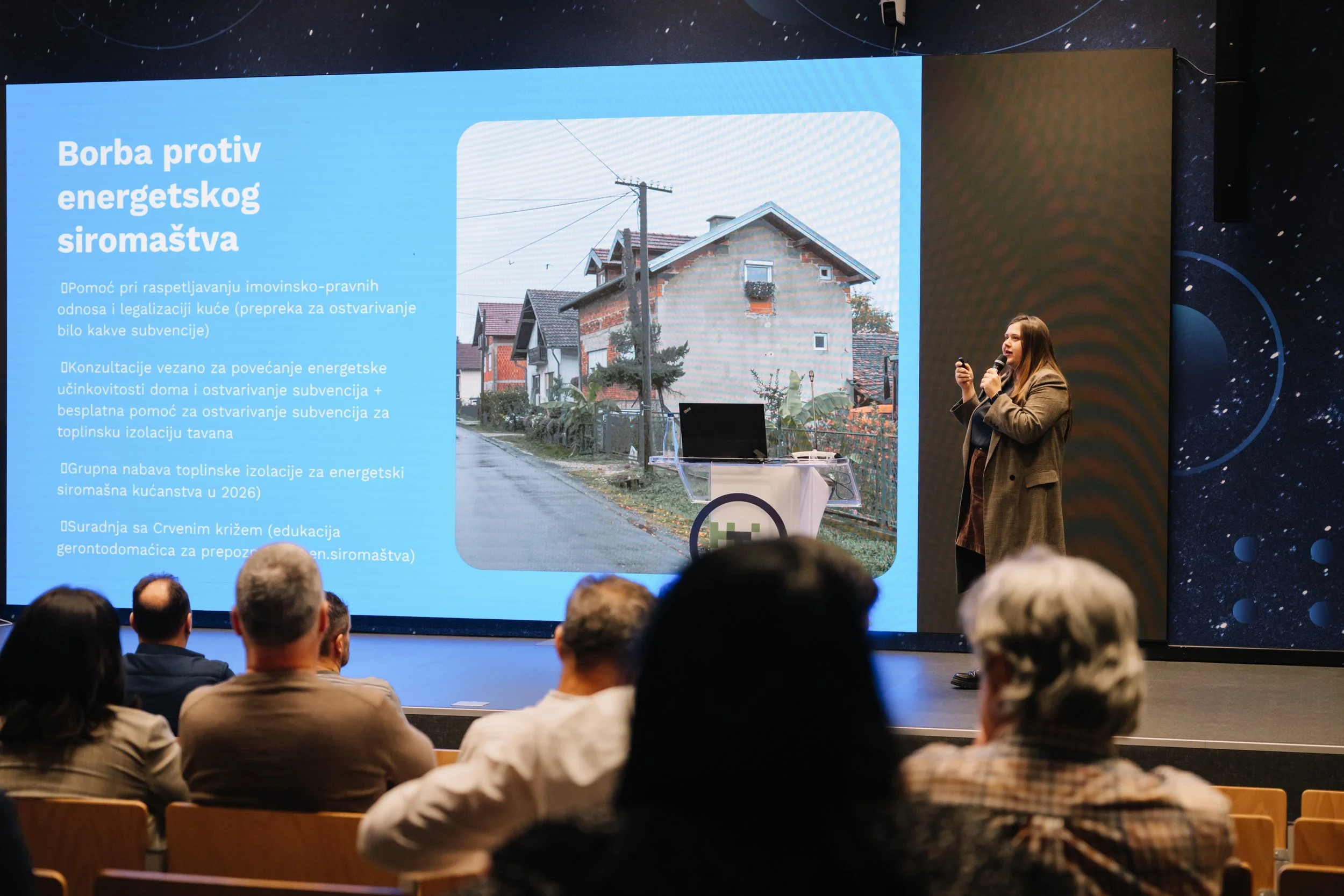
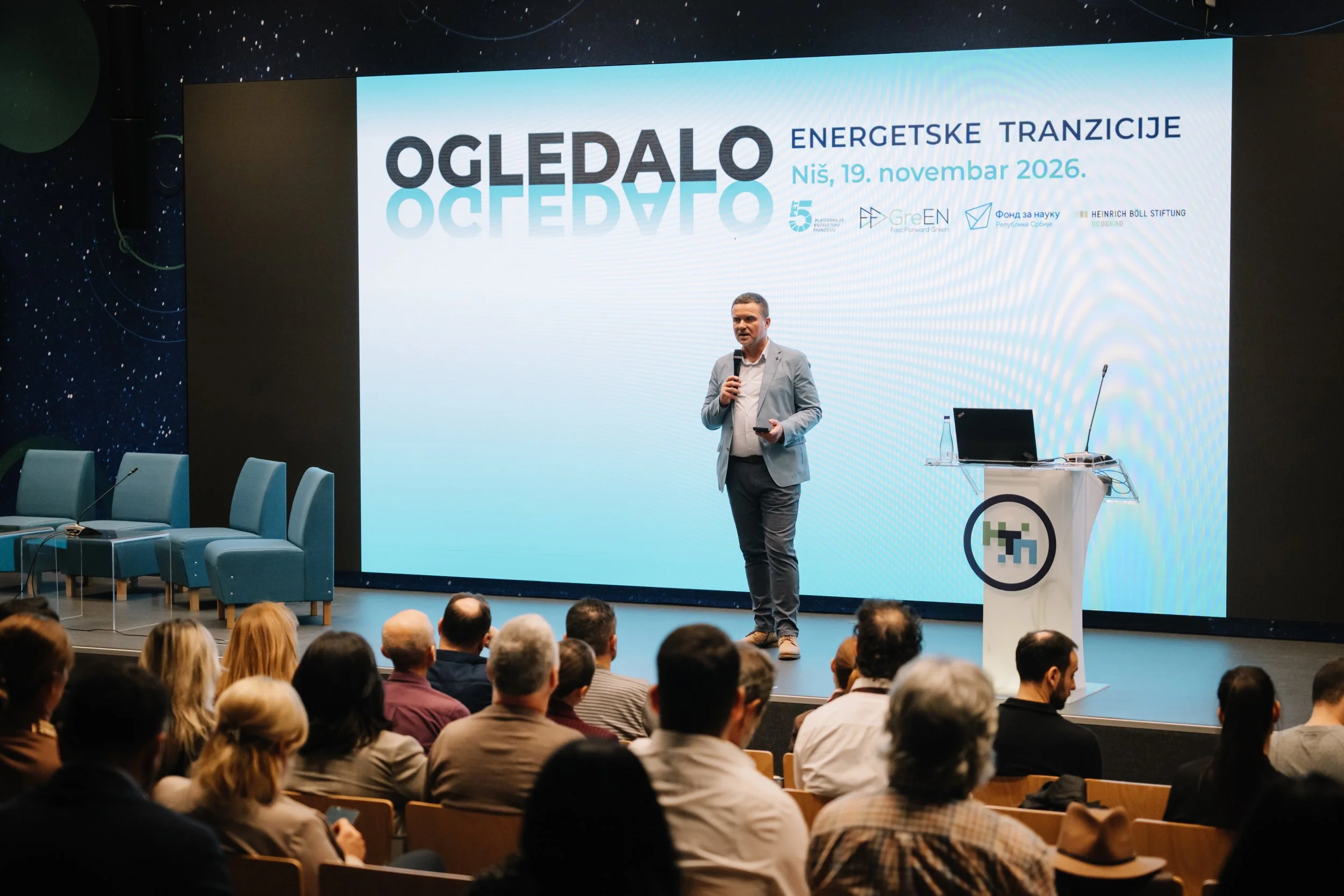
At PET’s annual conference in Niš, researchers, local governments and energy cooperatives from Serbia, Croatia and Montenegro discussed how citizens can move from observers to drivers of change.
How much can citizens really influence the energy future of their communities, and what does it take for their ideas and cooperation to turn into concrete change? These were the central questions of “Mirror of the Energy Transition”, PET’s annual conference held on 19 November 2026 at the Science and Technology Park in Niš.
This year’s guest was the FF GreEN project, funded by the Science Fund of the Republic of Serbia under the PRISMA programme, which used the conference to present its final results. The event brought together representatives of local governments, academia, civil society and energy cooperatives from Serbia, Montenegro and Croatia, with one shared goal: to look honestly at where citizens stand in the energy transition and what is still missing.
Citizens are ready. Are institutions?
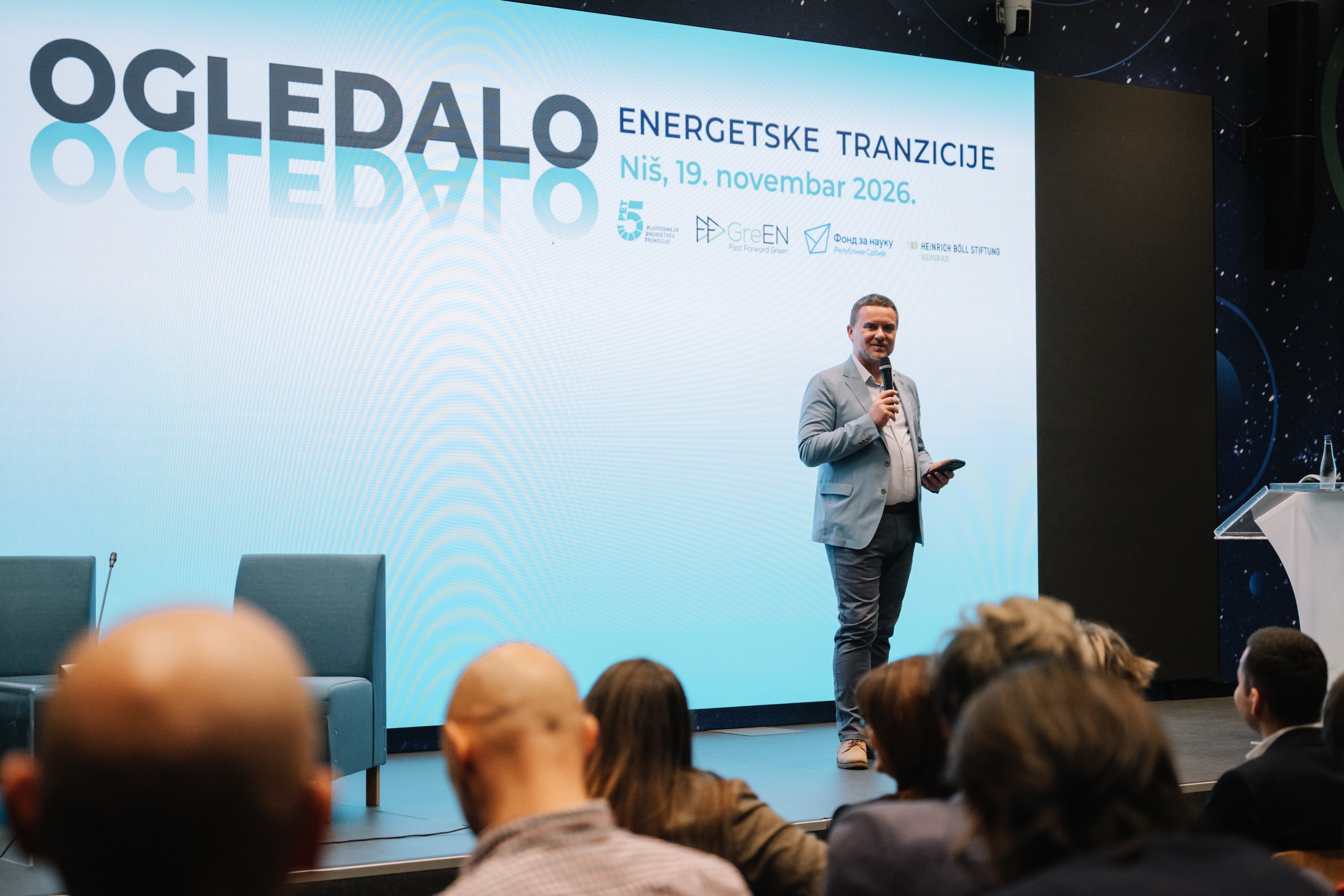
Opening the conference, Bojan Gajić of the Platform for Energy Transition set the tone for the day.
“The energy transition does not happen only in ministries and power plants, but in our homes, buildings and local communities. Experience from Serbia and the region shows that citizens want to participate, invest and join forces, but they need a system that hears and supports them. The question today is no longer whether citizens are ready, but whether we, as institutions and the expert community, are ready to truly build their views into local decisions,” Gajić said.
The conference was built around a few key questions. Citizens can get involved in many ways: through surveys and public opinion research, awareness campaigns, citizen energy initiatives, cooperatives and participation in projects. But what are the preconditions? Participants discussed raising awareness, supporting citizen energy initiatives, advocating with local authorities and, above all, giving citizens a real role in decision-making.
A roadmap for cleaner heating in Vranje
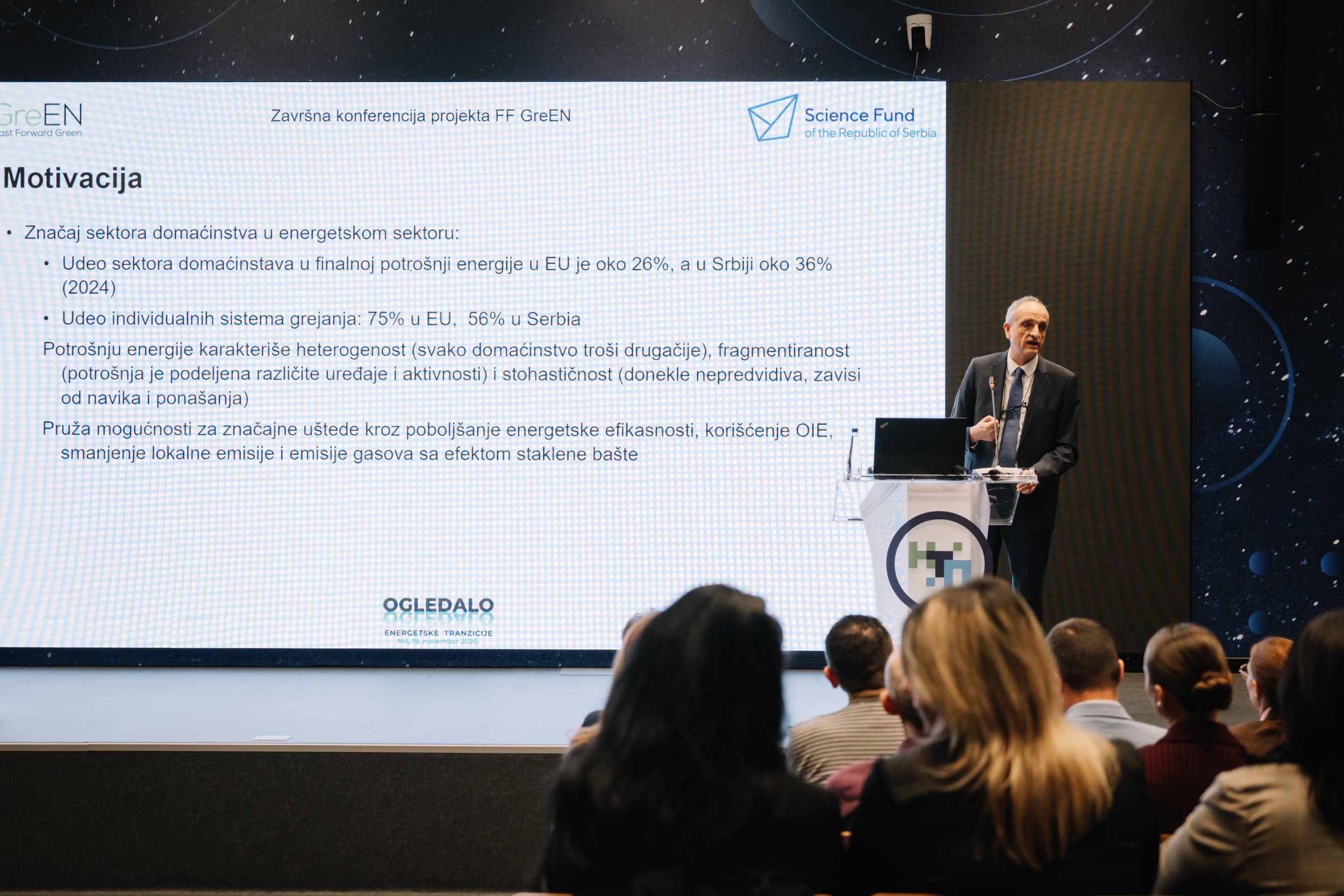
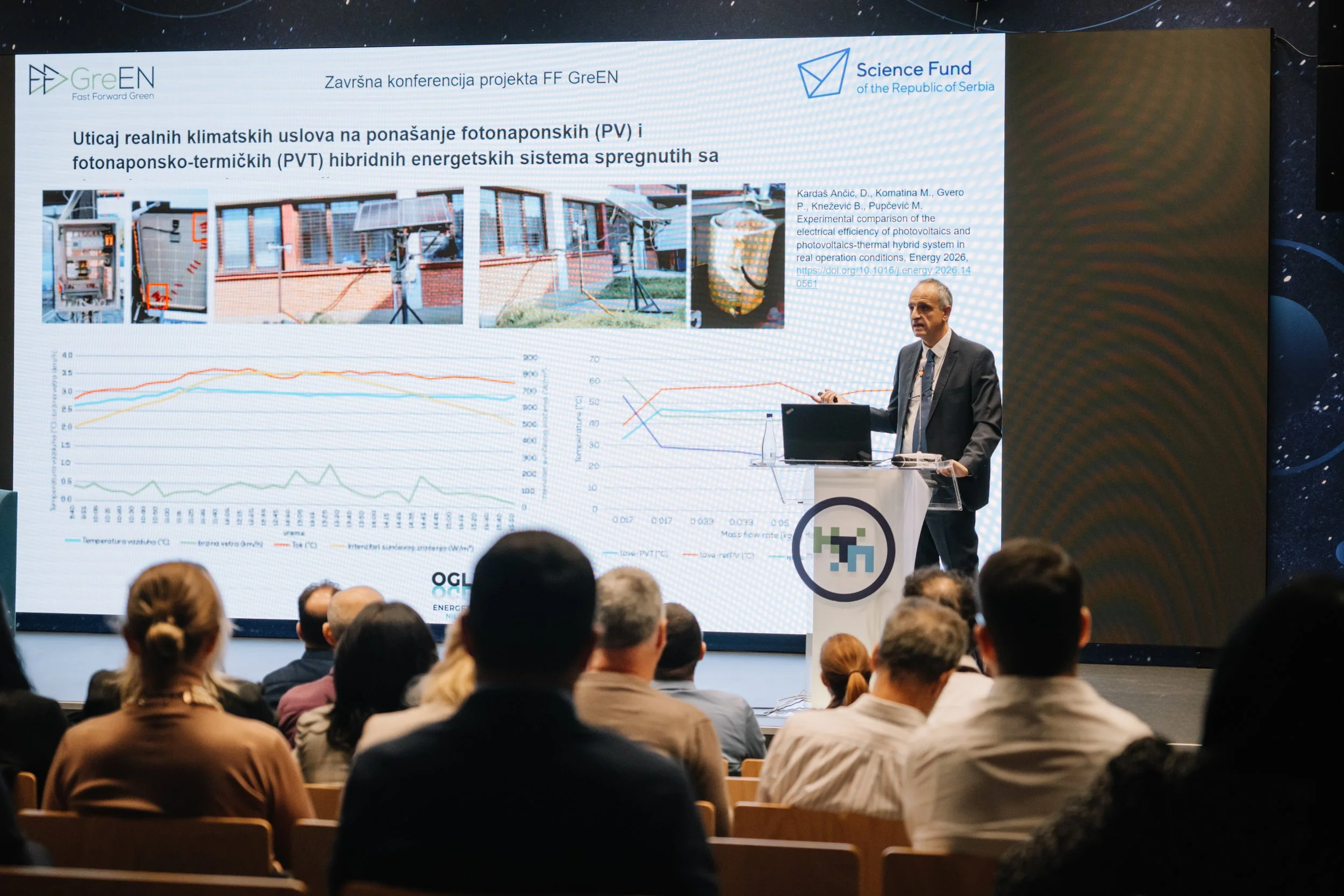
Dejan Ivezić, PhD of the Faculty of Mining and Geology, University of Belgrade, presented the “Roadmap for the Energy Transition of Households”, the key result of the FF GreEN project. The roadmap was developed for the city of Vranje by combining energy modelling with an analysis of how households actually behave, through participatory planning and simulations of household decisions.
According to the roadmap, CO2 and local pollutant emissions from household heating in Vranje could be cut by 50 percent by 2035, with an additional 200,000 square metres of residential space connected to district heating.
“The research shows that a successful green transition depends not only on new technologies, but also on understanding citizens’ needs, involving them in decision-making and carefully designed incentives. In Vranje, we showed how cooperation between science, local governments and citizens can lead to cleaner air and a sustainable energy future,” said Ivezić.
Who gets left behind?
The view from Croatia came from Martina Nemčić, EU Climate Pact Ambassador and programme manager at the KLIK energy cooperative from Križevci. Her message was clear: the energy transition is not only about counting installed kilowatts and subsidies, but about who decides, who invests, who benefits and who is left out.
According to Eurostat figures she cited, 51 percent of people in Croatia who are not connected to district heating heat their homes with firewood, rising to 66.6 percent among those at risk of poverty. Energy price caps protect electricity and gas, but not firewood. Many of the most vulnerable households cannot even apply for subsidies because their property documents are not in order, and some live in houses whose roofs could not carry a solar installation. Household wood burning, she noted, is the main source of PM2.5 particles in Croatia, where more than 3,500 people are estimated to die prematurely each year due to air pollution.
This is why KLIK runs a local one-stop-shop that supports citizens along the whole path, from sorting out paperwork and applying for subsidies to planning, financing and carrying out home renovations and solar installations. Often, she said, people first come for help with property issues, and only then for the energy transition.
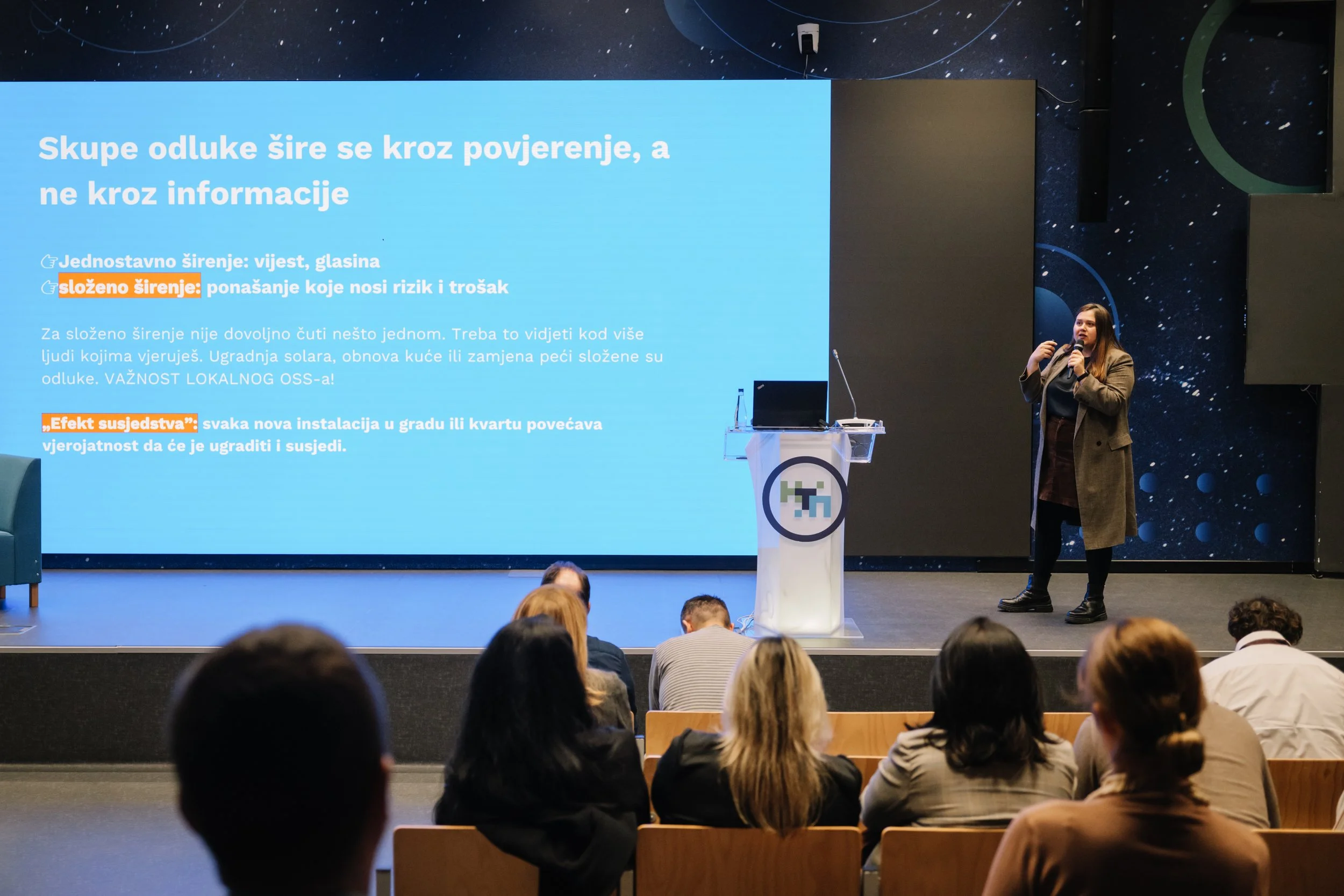
Nemčić also explained why local, trusted places matter so much. Decisions like installing solar panels, renovating a home or replacing an old stove are costly and risky, and people do not make them after hearing about something once. They need to see it with people they trust. Every new installation in a neighbourhood increases the chance that the neighbours will follow.
“The transition succeeds when it starts with measures people accept. Costly decisions spread through trust, not through information,” Nemčić said.
From public opinion to public policy
The panel “From public opinion to public policy: how to involve citizens?” was moderated by Tanja Popovicki of PET. She framed the discussion as a ladder of citizen involvement: from informing citizens and researching their views, through involving them in decision-making, to citizens becoming owners, which is exactly what energy cooperatives make possible. Each panellist reflected on where their community stands on that ladder and what it takes to reach the next step.
Prof. Dr. Marija Živković, member of the FF GreEN research team who took part in developing the roadmap, noted that citizens care about savings, but increasingly also about the air they breathe. Technical solutions exist, she said, but the real question is whether people are ready to change, and the process is still slow. Her advice to local governments: build trust between the municipality, the experts and the citizens involved from the very first step, so that people feel their opinion matters. Everyone, she added, needs to find their own motive to take part.
Zenepa Lika of the Dr. Martin Schneider-Jacoby Association (MSJA) from Ulcinj reminded participants that energy is part of environmental protection, and that people engage most readily when change feels personal. Her example was the Ulcinj Salina, where generations of local families worked. Thanks to a combination of civic activism and local government support, the Salina was declared a nature park in 2019. Without citizens, she said, it could never have been protected.
Goran Čačić of the Green Energy Cooperative (ZEZ) from Zagreb stressed that only a small number of people are motivated to take on responsibility for decision-making. To bring more of them in, people need to see clear benefits from getting involved, and the process must be simple, with clear steps and a clear explanation of what community participation actually means. Citizen initiatives also need technical and financial support, since on their own they cannot compete with large market players. Cities and municipalities, he believes, should lead the way.
Ana Džokić, co-founder of the Elektropionir energy cooperative, which built the first cooperative solar power plants in Serbia, described this as an exciting moment in which cooperatives are showing how democratic governance, based on the principle of one member, one vote, can work in practice. Asked what cooperatives need from institutions, she pointed to access and open dialogue. She also spoke about how the process of building their plants looked, where they got stuck and how they brought local communities on board.
Mladen Đurić, President of the City Municipality of Medijana, sent a clear message to citizens: everyone can apply for support. People and housing communities, he said, get involved when they see a well-organised system that works, and he highlighted the municipality’s good cooperation with the Platform for Energy Transition.
Everyone has the power
Three shared messages emerged from the panel. Citizens engage when they see concrete benefits and a clear, simple process. Trust between citizens and local governments is built through open dialogue and a well-organised system. And citizen initiatives need expert and financial support to survive.
When the energy transition looks in the mirror, the answer is clear: everyone has the power to drive it. But no one can do it alone. The public sector must take its share of responsibility to inform, inspire and create conditions in which citizens’ voices truly make a difference.
PET thanks all speakers, partners and participants for an open and honest conversation, and looks forward to continuing it in our communities.
This research was supported by the Science Fund of the Republic of Serbia, Grant No. 4344, Forward-Looking Framework for Accelerating Households’ Green Energy Transition – FF Green.